also available here with notes
Saturday, November 17, 2007


Sunday, November 11, 2007
Wardround 9xi7
 The two minute talks this week were based around “the use of...” various drugs. I hope that these have stimulated some thought....and curiosity about other drugs you use regularly. It is important as you continue in your training to give increasing thought to the reasons and evidence behind the guidelines and advice associated with drugs.
Gentamicin: (SS) a drug with a narrow therapeutic window. Various methods exist for monitoring gentamicin levels. The aim is to give the correct dose (to achieve levels high enough for effect and low enough to be safe). It is because dose calculations do not always predict the correct dose that levels must be monitored to allow fine tuning of dose and frquency.
Thrombolytics (HJ) nostalgia prompted my question about fibrinolytics (apologies). Another drug with significant risks to balance against benefits. Before PCI was easily available the decision for patients with a relative contra-indication was thrombolyse or nothing and greater risks may have been accepted than would now be appropriate.
Amiodarone (JB) the ‘greedy’ anti-arrythmic with a bit of each class activity, broad spectrum activity and plenty of drawbacks. Time to review the Vaughn Williams Classification, but before you do revise, the cardiac action potential. I used to find it difficult to understand the why particular drug classes had their effects until tied them in with the action potential and the fact, that escaped me for years, that the fast depolarisation channel in the SA node and AV node is calcium rather sodium mediated.
Heparin (R) I hold my head in shame. I did not know that heparin could produce hyperkalaemia yet the Oxford textbook says hyperkalaemia occurs in 7% of heparin treated patients due to inhibition of aldosterone production. I will be on the look out now.
Warfarin (HA) I now know that vitamin K is named for Koagulation. You now know why we need to continue heparin for a couple of days after the INR is therapeutic. That pesky protein C.
For next week you are excused the two minute tutorials but sentenced to the three minute tests. You will be asked to give the initial management of an emergency. There aren’t that many possibilities, so get revising.
The paper discussed on Tuesday was Thoughts for new medical students at a new medical school, Richard Smith. By the way, have you read his articles about Dumfries? How about leaving your advice for newly appointed house officers in the comments? I’ll post it with your photo in the hall of fame if you like.
For next Tuesday I would like you to read In a stew. Michael A Lacombe. American Journal of Medicine. 1991;91:276-278. If you feel up to it, read the associated editorial Double trouble, boil and bubble. And ask yourself how I came across these articles in a journal I do not regularly read.
Interesting Topics
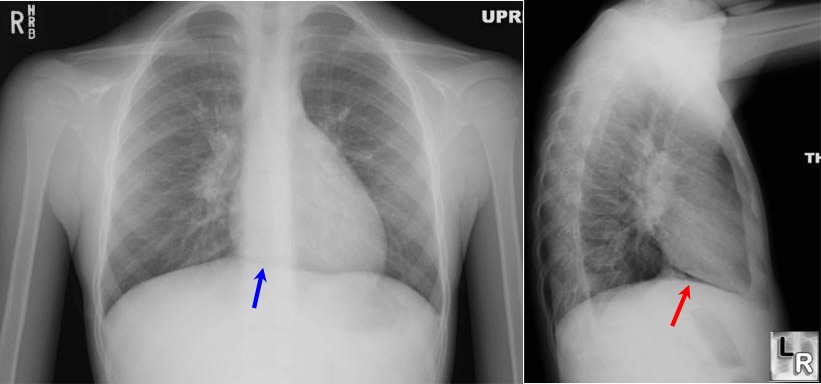
Pneumomediastinum
See also this link which explains the X-ray above.
MJM
Friday, November 02, 2007
wardround 2xi7
 This week’s read and think had been The homeless man on morning rounds, an essay by J Lowenstein. If you found it interesting , you might want to read some of his collected essays in The Midnight Meal.
For next Tuesday I would like you to read Thoughts for new medical students at a new medical school, Richard Smith BMJ 2003;327:1430-1433 (20 December),
…and tell me which is your favourite box in the paper.
This week’s two minute tutorials were themed around respiratory problems, addressing the respiratory history (nicely done SS, don’t forget occupational history); PFTs (needed a bit more work on transfer factor etc, KM); ABGs (good clear talk AA; NIV (you should have been able to explain why BiPAP helps, HA); The assessment of a breathless patient (quite rightly focussed on practical issues such as beginning treatment and assessment at the same time, getting help, IV access etc, but was a four minute talk in two minutes, JB).
For next week the theme is “The use of…”
Warfarin HA
Heparin JR
Gentamicin SS
Amiodarone JB
Thrombolytics HJ (are they really fibrinolytics?)
Two minutes please, keep it concise yet precise. Arm yourself, intellectually, to ward off those probing questions.
Interesting topics this week
Hyponatraemia again
Vasculitis
MJM
Monday, October 29, 2007
Wardround 26x7
The paper for discussion on Tuesday will be The homeless man on morning rounds from The Midnight Meal and Other Essays about Doctors, Patients, and Medicine by Jerome Lowenstein. I have left a copy on the ward. ...and what is a home?
The two minute tutorials for Friday will have a respiratory theme.:
A respiratory history SS
PFTs KM
CXR interpretation HJ
ABG interpretation AA
The approach to the (acutely) breathless patient JB
NIV HA
These will be a challenge. Remember to keep it concise yet precise. Don't try to squeeze too much information in. Produce a handout and quote your sources.
Interesting topics:
Has Chlamydia changed to Chlamydophila?
The two minute tutorials for Friday will have a respiratory theme.:
A respiratory history SS
PFTs KM
CXR interpretation HJ
ABG interpretation AA
The approach to the (acutely) breathless patient JB
NIV HA
These will be a challenge. Remember to keep it concise yet precise. Don't try to squeeze too much information in. Produce a handout and quote your sources.
Interesting topics:
Has Chlamydia changed to Chlamydophila?
Thursday, October 25, 2007
Extra-articular RA
A brief talk about extra-articular disease in RA.
If you cannot see the pictures look at this other version.
Monday, October 08, 2007
Wardround 5x7

Thank you for the talks on skin infection which I very much enjoyed. I hope you now have a background knowledge to help you choose, or guide the choice, of antibiotics and their route of administration. Remember to ask yourself "what can I do to reduce the likelihood of recurrence?" when you see a patient with these disorders. What would you do?
The two minute talks for next weekwill be on Atrial Fibrillation: two minutes please on the topics listed. Keep it concise yet precise, educate yourself and your colleagues, and quote your sources. Keep the info sheet short and simple.
assessing thrombotic risk AA
the case for rate control SYC
the case for rhythm control KM
If anybody else wishes to join the group they must bring a two minute talk.
I do not think there will be time for a discussion paper on Tuesday (reasons will become obvious) but for next week I would like you to read Risk: aspirin or car? in Bandolier. The original paper this refers to is available via the elibrary and is worth a look especially the discussion section.
What's More Dangerous, Your Aspirin Or Your Car? Thinking Rationally About Drug Risks (And Benefits). Cohen, Joshua T.; Neumann, Peter J.. Health Affairs, May/Jun2007, Vol. 26 Issue 3, p636-646; DOI: 10.1377/hlthaff.26.3.636
Interesting topics this week:
Erythromelalgia
Pseudobulbar palsy.
MJM
Monday, September 24, 2007
21ix7

Our two minute talks last week were based on the investigation of abnormal LFTs but we got sidetracked into the interpretation of hepatitis B serology. This was I hope a useful time both for the specifics of understanding HepB serology and the general point of structuring your knowledge in a way which is useful for practical use. When learning a new topic, or revising an old one remember that the way it is structured in the textbook may need translating to make it easier to remember or apply.
Test yourself…which tests are useful for:
Assessing response to Hep B immunisation?
Checking for previous contact with Hep B?
Acute hepB?
Chronic Hep B?
Next is Opportunistic infection (in HIV)
Pneumocystis SYC
Cytomegalovierus AA
Atypical Mycobacteria AA
Kaposi’s MR
Two minutes please. Keep it precise and concise, quote your sources and educate your colleagues.
Last week’s discussion was about waste and how we might address the problem. This week we will discuss Measuring quality of life. Is there such a thing as a life not worth living? B. Farsides, RJ Dunlop BMJ 2001;322:1481-1483.
Next week the Tuesday discussion will be replaced with (by?) a quiz.
Interesting topics
PEG tubes
Aortic stenosis: indications for valve replacement in adults (uptodate)
MJM
Sunday, September 16, 2007
Wardround 14ix7

The two minute talks for next week will be about the appropriate use of investigations in the patient with abnormal LFTs. Tell me how to use and interpret:
Viral tests AA' s successor
autoimmune serology (and metabolic tests if you can fit it in) MR
imaging SYC
The paper for discussion on Tuesday is WASTE IN THE NHS: THE PROBLEM, ITS SIZE, AND HOW WE CAN TACKLE IT. Andrew Moore, Bandolier.
For Tuesday 25th the discussion paper is Measuring quality of life. Is there such a thing as a life not worth living? B. Farsides, RJ Dunlop BMJ 2001;322:1481-1483.
Interesting topics:
Sheffield tables
ETTs - have a look at Ordering and Understanding the Exercise Stress Test by M Darrow.
Aspirin primary prevention there is much written on this, but you have to start somewhere
Monday, September 10, 2007
Wardround 7ix7
The two minute talks for next Friday will be on the Organisms causing community acquired pneumonia and their associated clinical syndromes. Two minutes please on:
Pneumococcus AA
Mycoplasma SYC
Chlamydia (has its name chasnged?)
Legionella MR
The paper for discussion a week on Tuesday will be WASTE IN THE NHS: THE PROBLEM, ITS SIZE, AND HOW WE CAN TACKLE IT. Andrew Moore DSc, Editor of Bandolier.
MJM
Pneumococcus AA
Mycoplasma SYC
Chlamydia (has its name chasnged?)
Legionella MR
The paper for discussion a week on Tuesday will be WASTE IN THE NHS: THE PROBLEM, ITS SIZE, AND HOW WE CAN TACKLE IT. Andrew Moore DSc, Editor of Bandolier.
MJM
Monday, September 03, 2007
Wardround 31viii7
The ophthalmoscope, stethoscope, pulse oximeter, otoscope and sphygmomanometer all explained in less than half an hour...what an achievement. I still remain uncertain about the correct cuff size for a sphyg. The AHA arec quoted as saying Proper cuff size selection is critical to accurate measurement. The bladder length and width of the cuff should be 80% and 40%, respectively, of the arm circumference. Blood pressure measurement errors are generally worse in cuffs that are too small vs those that are too big. That sounds like an audit just waiting to happen.
For next week we will ahve two minute talks on practical procedures:
Blood cultures (including from lines) GAJ
Chest drain insertion AA
LP AW
Ascitic tap AG
Joint aspiration MJM
The paper for discussion this week was What patients want to know about adverse events. Whatever we may think, the people who took part in this study wanted to know just about everything. We may disagree or have reasons why we believe this is impractical, but should not dismiss it out of hand. Try asking a patient "What do you want to know about this treatment?" next time you suggest something.
The paper for discussion on 11 September is....to be decided.
Interesting topics
Haemolysis
MJM
For next week we will ahve two minute talks on practical procedures:
Blood cultures (including from lines) GAJ
Chest drain insertion AA
LP AW
Ascitic tap AG
Joint aspiration MJM
The paper for discussion this week was What patients want to know about adverse events. Whatever we may think, the people who took part in this study wanted to know just about everything. We may disagree or have reasons why we believe this is impractical, but should not dismiss it out of hand. Try asking a patient "What do you want to know about this treatment?" next time you suggest something.
The paper for discussion on 11 September is....to be decided.
Interesting topics
Haemolysis
MJM
Monday, August 27, 2007
Wardround 24viii7

Thank you for your ideas about the cause of the plague in Athens. If you want to read more there is much to be found on the internet. If you would like to see a published discussion about the plague of Athens have a look at The cause of the plague of Athens: plague, typhoid, typhus, smallpox, or measles? Burke A. Cunha, Infect Dis Clin N Am 18 (2004) 29–43.
The two minute talks for this week will be about instruments in medicine:
Ophthalmoscope GAJ
Stethoscope AG
Saturation meter MJM
Auroscope AW
Sphygmomanometer AA
Two minutes please. Keep it precise and concise, and quote sources.
The reading for next week (4ix7) will be Metaphorical Medicine: using metaphors to enhance communication with patients who have pulmonary disease. Arroliga AC et al. Ann Intern Med. 2002 Sep 3;137(5 Part 1):376-9
MJM
Monday, August 20, 2007
Wardround 17viii7
 The Roth Spot is a white-centered hemorrhage. It is a cotton wool spot surrounded by hemorrhage. The cotton wool comes from ischemic bursting of axons; the small hemorrhage comes from ischemic bursting of a pre-capillary arteriole. It is not specific to bacterial endocarditis.
I will scan in this week's handouts on HSVE and JE. The prize for best talk this week goes to Dr Anderson for a novel way of presenting the information about Japanese encephalitis.
Herpes simplex encephalitis
Japanese encephalitis
The talks this week are your diagnostic choices for the plague of Athens. Read the article and come up with a diagnosis. You have two minutes to convince the group you are correct.
The History of the Peloponnesian War written by Thucydides in 431 B.C. If you click on the link it will take you to a copy of the piece. The web page begins with chapter VI, but you can skip down to chapter VII (unless you would like to read about the war). If you cannot find the right section, press ctrl-F and type in plague.
Don't forget to read Does this patient have abnormal central venous pressure? Cook, Deborah J; Simel, David L JAMA; Feb 28, 1996; vol 275 (8): 630-634, for Tuesday.
Interesting topics
MJM
Monday, August 13, 2007
Wardround 10viii7

This week’s talks were about common drugs.. Coamoxiclav, Loop diuretics, LMWH and aspirin. You will become aware over time that I tend to be impressed by talks with a practical bent to them. So I may not care that furosemide is protein bound, but I am very interested that its effectiveness may be impaired in nephrotic syndrome due to the drug remaining bound to protein in the tubular lumen, since I need to give higher doses. It was good to see sources quoted. The week’s prize to Dr Reidy: good handout, sources quoted and an interesting slant on aspirin.
The reading last week had been A Necessary Inhumanity? Ruth Richardson. Journal of Medical Ethics 2000;26;104-106. The inhumanity discussed is apparently developed by doctors, for our own protection and to allow us to provide better care. We call it clinical detachment. I have no douibt that some doctors are inhumane, as her examples illustrate, but are we all? I do not think that I am inhumane when I remain calm (detached from the expected emotional response) in the face of severe illness in my patient. What do you think?
The talks for the coming week are related to encephalitis:
Herpes simplex encephalitis Dr Reidy
West Nile Virus Encephalitis Dr Waters
Japanese encephalitis Dr Anderson
Cerebral lupus Dr Ghanbari
The reading for next week is Does this patient have abnormal central venous pressure? Cook, Deborah J; Simel, David L JAMA; Feb 28, 1996; vol 275 (8): 630-634
Interesting topics
Staphylococcal septicaemia, excellent articles in uptodate.
MJM
Friday, August 03, 2007
Wardround 3viii7

The new session begins and with next to no warning the new batch came up with two minute talks on the normal ECG. We heard about the p wave from Dr Ghanbari, PR interval from Dr Waters, QRS from MJM, ST from Dr Reidy, T wave from Dr Anderson and Axis from Dr Cameron. You can see a brief resume of a normal ecg here. The prize for best talk goes to Dr Cameron for making a difficult topic so simple that a big brother halfwit would understand it.
Now that you have all had a chance to see how the talks are done I can give the assignments for next week and be a bit more insistent about the rules. Next week’s two minute tutorials will be on common drugs:Low molecular weight heparin (Dr Waters)
Aspirin (Dr Reidy)
Co-amoxiclav (Dr Anderson)
Loop diuretic (or was it PPI?) (Dr Ghanbari)
Keep it concise yet precise. Practical rather than theoretical. Heretical if you must. Produce a handout and quote your sources. This is helpful for your colleagues. If they find it interesting they can go and read it themselves.
Next Tuesday’s reading you already have. For the Tuesday after we will read The homeless man on morning rounds, from The midnight meal and other essays about doctors, patients and medicine. By Jerome Lowenstein. I will put a copy on the ward next week.
Interesting topics arising this week:
Aspiration Pneumonia, good article on Uptodate
Tuesday, July 31, 2007
Welcome to Ward 10
 Farewell to the old guard and welcome to the new batch. Get ready to gorge yourself on fruit from the tree of knowledge.
This blog will be a reminder of your training assignments each week. In addition to your usual training there are two recurring assignments:
Two minute presentations
You will give a two minute presentation to the team each Friday. The topic for your talk each week will be recorded here. The aim is to enlighten yourself and your colleagues about the subject. You are only allowed two minutes (we have a timer) so don’t waste time waffling about why you chose to talk about the subject, just get down to it. This is a difficult task but not impossible, many have done it before you. The sources of your information should be mentioned. An A4 size handout is encouraged. Have a look at this example... Anaphylaxis by Dr Hannah Gunn, or this slightly busier one on aspiration pneumonia by YT. The talk is more important than the handout so use your time appropriately.

Read and think
There is a paper to read each week. These are to stimulate discussion so read them in good time so you have time to think before we discuss them on Tuesdays.
You will be given timetables for wardrounds, clinics etc when you arrive.
The read and think for next week will be
A Necessary Inhumanity? Ruth Richardson. Journal of Medical Ethics 2000;26;104-106
You should be able to get the PDF using your Athens password.
MJM
Sunday, July 01, 2007
Wardround 29vi7

Our two minute talks this week were about endocrine disorders, specifically the clinical features of hypoadrenalism, hypothyroidism and hyperprolactinaemia. This has stimulated me to be more aware of prolactin levels in my patients with unexplained symtoms.
For next week we will be focussing on the eye with topics of the sore/red eye, visual loss and diplopia. So two minutes please on the work up and management of patients with these common problems.
The reading for next week will be Does This Patient Have Temporal Arteritis? Smetana and Shmerling. JAMA.2002; 287: 92-101. Get it via the elibrary. Hopefully we can start the meeting on time and be able to discuss the paper this time.
Interesting topics
Miller-Fisher Syndrome
And for those who fancy a trip to the real library, why not have a look at An unusual variant of acute idiopathic polyneuritis (syndrome of ophthalmolplegia, ataxia and areflexia). M Fisher:
New England Journal of Medicine, 1956, 255: 57-65.
MJM
Wednesday, June 27, 2007
Tardy wardround

Sorry folks. The posting is late this week due to foreign travel and computer problems.
I will just cut to the quick and give next week's reading:
BMJ 2003;326:151 ( 18 January )
Filler
EndpieceA good physician versus no physician
The difference between a good physician and a bad one is certainly very great; but the difference between a good physician and no physician at all, in many cases, is very little.
If during the course of the common epidemic diseases which occur in this island every spring and autumn, two hundred patients were taken promiscuously, and one half delivered to the care of the faculty to be treated according to the art; that is, as private patients by whom they are fee'd every time they prescribe, and the other half delivered to the care of nurses, instructed to give them no physic whatever, but merely cooling drinks, and such light and simple foods as the patients' appetites might lead them to, I am convinced the world would be a good deal surprised at the result of the experiment.
J Moore, Medical Sketches. London: A Strahan and T Cadell, 1786
Jeremy Hugh Baron, honorary professorial lecturer, Mount Sinai School of Medicine, New York
Remember that a short read means more time for reflection.You already have your assignments for two minute talks on endocrine dysfunctions.
MJM
Saturday, June 16, 2007
EULAR
The EULAR meeting has been interesting and thought provoking. As well as the usual expected tide of data regarding biologics efficacy and safety, there has been a growing focus on strategies for treating Rheumatoid disease. More of which over the next few days.
Other sessions included neuroendocrine and intracrine influences on RA, circadian rhythms, SLE and crystals.
I hope the team back on Ward 10 will choose a subject for the two minute talks next week.
MJM (Barcelona)
Other sessions included neuroendocrine and intracrine influences on RA, circadian rhythms, SLE and crystals.
I hope the team back on Ward 10 will choose a subject for the two minute talks next week.
MJM (Barcelona)
Sunday, June 10, 2007
Wardround 8vi7

 The two minute talks this week were stimulated by a recent case of tetanus. We heard about the toxin effects of Tetanus (J Wallace); C. diff (G Bell); Botulism (N Mohan); Staph Toxin (L Frame). Very interesting topics. I was not aware of the neuromuscular effects of aminoglycosides. My prize goes to NM. You can find out more trivia about botulism at Naveen’s blog.
For next week’s talks we will address the four giants of geriatrics. Our mental search for the fifth giant reminded me of Terry Pratchett’s fifth horseman of the apocalypse. I once did a podcast on the subject and remain taken by the thought of that fifth horseman, Ronnie, who left before they became famous. The assignments for next Friday are:
Falls (MJM’s SHO)
Delirium (KL)
Incontinence (JW)
Immobility (NM)
Two minutes please. Keep it precise and concise, quote your sources and make a one page handout that is so perfect people will want to keep a copy to show their grandchildren. Given the subject matter I would prefer that you avoided practical demonstrations, especially JW.
The paper discussed this week was The dogged physical examination in the era of the C.A.T. Riegelman K. Primary Care 1980 Dec;7(4):625-35. I hope this has stimulated each of you to think about those parts of the exam that are particularly useful, yet easily and often omitted. You might want to read the last paragraph of the previous paper as well.
For next week I would like you to read and think about: Aunt Sophie’s Choice: the perils of paternalism. Schafer A.
PS beware Pratchett's four minor horsemen of the apocralypse: panic, bewilderment, ignorance and shouting.
MJM
Sunday, May 13, 2007
Wardround 11v7

Next week’s two minute tutorials are on dangerous drugs. Two minutes please on:
Warfarin GB
Antibiotics JW
Antipsychotics LF
Aspirin R
Steroids SS
Let’s lift ourselves up...no lacklustre talks this week please. No excuses. Give the group an interesting couple of minutes on your topic.
The read and think for next week is The rational clinical examination: Is this patient clinically depressed? Williams JW, et al. JAMA 2002; 287: 1160-70.
Interesting topics:
Wegener’s granulomatosis
Diffuse alveolar hemorrhage syndromes. U Specks. Current Opinion in Rheumatology. 13(1):12-17, January 2001.
MJM
Subscribe to:
Posts (Atom)