This week’s two minute talks were themed around hospital acquired infection:
HA UTI (DL) and HA Pneumonia (BW), both were well researched and almost to time. Could I ask that next week you begin to list your sources so that others can follow up on reading.
For next week the theme will be anti-viral treatments, with assignments as follows:
Hepatitis C (BW)
Hepatitis B (?GAJ)
Herpes viruses (MJM)
Influenza (CC)
SARS (LD)
Keep to time, be concise but precise, and quote your sources.
The paper for discussion had been: Changing the Paradigm for HIV Testing — The End of Exceptionalism. Ronald Bayer, Amy L. Fairchild. NEJM August 17 2006, Volume 355:647-649. Apologies to everyone for my rather abrupt and dogmatic devil’s advocacy. The paper, though ostensibly about a specific ethical issue, does offer food for thought about informed consent in general. A study has been done in D&G surveying patient's views about consent in lab testing, so perhaps we can bring that along for discussion sometime?
For next week’s reading I thought we might have something clinical rather than ethical. So let’s give some thought to syncope. Read Current evaluation and management of syncope. Kapoor WN. Circulation, Sept 24, 2002;106 (13):1606-1609.
Interesting topics this week
Periodic fever
Herpes Encephalitis
Tilt testing
uptodate also has a good introductory article on the subject.
MJM
Sunday, August 27, 2006


Friday, August 18, 2006
Wardround 18viii6

The reading for this week and the two minute talks were themed around the Plague of Athens. All well thought out with logical approaches to diagnosis. The internet is full of sites discussing the possible diagnoses, but you might find this article useful:
The cause of the plague of Athens: plague, typhoid, typhus, smallpox, or measles? Burke A. Cunha, Infect Dis Clin N Am 18 (2004) 29–43.
Now I know DL had difficulty getting these out of the eLibrary but I have tried again today and could access the PDFs without difficulty (except having to enter my athens password twice). Go on take the challenge…access this journal on-line. I have left a copy on the ward if you are unsuccessful. This copy of Infect Dis Clin N Am has a historical theme and the other articles are worth a look. I particularly liked:
Osler on typhoid fever: differentiating typhoid from typhus and malaria. Cunha BA. Dis Clin North Am. 2004 Mar;18(1):111-25.
Next week’s two minute tutorials are on hospital acquired infection:
Dr Mohan will be leaving us but those left behind can fight on. Hosp. acquired UTI (Dr Lindsay), Hospital Acquired pneumonia (Dr Williams). Two minutes please keep it concise and precise.
The reading for next week is for once quite up to date. Changing the Paradigm for HIV Testing — The End of Exceptionalism. Ronald Bayer, Amy L. Fairchild. NEJM August 17 2006, Volume 355:647-649. Read and think
Interesting topics this week
Arteritis
Hypokalaemia
Ankylosing spondylitis
Typical/Atypical chest pain
MJM
Friday, August 11, 2006
Wardround 11viii6

The two minute tutorials this week were about diabetic retinopathy with Clinical features by NM and Management by VJ. Both were well prepared talks for such a broad subject. Dr Mohan gets this week’s prize (quoted his sources which included this which is worth a look. He has also posted more information at http://kmneo.blogspot.com/
This week’s reading was "Stepford doctors": an allegory. GM Sayers. Medical Humanities 2006;32:57-58. It seems more an analogy than allegory, and I am not sure that I agree completely with the article. Presumably it has been written to stimulate thought (and discussion) regarding the part doctors play in health care. It ends with this paragraph: This allegory cannot be concluded because it is ongoing. Some doctors refused to "reform" and transform into "Stepford doctors". They believed that their allegiance lay with their patients and not the masters. Those who did not leave the profession (as many did) remain part of the lineage from which they stemmed. They continue to defend the freedom to practise the sort of medicine their patients want. Only time will tell whether these doctors become extinct or manage to inspire their followers to reclaim their vocation. What do you think?
Next week’s reading is The plague of Athens. The link for reading is in last week’s post (see below). You must decide on a diagnosis and will have two minutes to make your case on the 18th August.
Interesting topics this week
Hyperkalaemia (beware Lo-salt preparations)
Septic shock
Atrial fibrillation
Toxic confusional states
Cannabis lung
MJM
Sunday, August 06, 2006
Wardround 4viii6
This week’s two minute tutorials were about electrolytes:
Sodium Dr Mohan (excellent handout)
Creatinine Dr Joshi
Glucose
Calcium Dr Sykes
Magnesium MJM
This week’s prize goes to Dr Sykes. Would each of you post a sentence in the comments section about your subject please.
Next week's assignments are:
Clinical features of diabetic retinopathy (Dr Mohan)
Management of retinopathy (Dr Joshi)
Non-retinopathic eye disease in diabetes (up for grabs)
Two minutes please, keep it concise and precise and quote your sources.
The reading for this week was: Reassurance and the Warning on the Label. Jerome Lowenstein, from The Midnight Meal and other essays about Doctors, Patients, and Medicine (1997). In the essay Dr Lowenstein highlights the difference between advice and reassurance. We often attach warnings to advice given to patients along the lines of ..."we cannot predict whether it will work" or "we do not know what the effects will be". But reassurance must be free of such caveats since it is undermined by such additions. Do you agree?
The reading for Friday 11th will be "Stepford doctors": an allegory. GM Sayers. Medical Humanities 2006;32:57-58. Read and think.
The reading for Friday 18th is a description of the plague of Athens, written in 431BC by Thucydides in The History of the Peloponnesian War. If you click on the link it will take you to a copy of the piece. The web page begins with chapter VI, but you can skip down to chapter VII (unless you would like to read about the war). If you cannot find the right section, press ctrl-F and type in plague. The challenge is to make a diagnosis. You will have two minutes to make your case for the diagnosis of your choice. This will be in place of the usual two minute tutorials that week.
Interesting topics this week:
Hyponatraemia
MJM
Sodium Dr Mohan (excellent handout)
Creatinine Dr Joshi
Glucose
Calcium Dr Sykes
Magnesium MJM
This week’s prize goes to Dr Sykes. Would each of you post a sentence in the comments section about your subject please.
Next week's assignments are:
Clinical features of diabetic retinopathy (Dr Mohan)
Management of retinopathy (Dr Joshi)
Non-retinopathic eye disease in diabetes (up for grabs)
Two minutes please, keep it concise and precise and quote your sources.
The reading for this week was: Reassurance and the Warning on the Label. Jerome Lowenstein, from The Midnight Meal and other essays about Doctors, Patients, and Medicine (1997). In the essay Dr Lowenstein highlights the difference between advice and reassurance. We often attach warnings to advice given to patients along the lines of ..."we cannot predict whether it will work" or "we do not know what the effects will be". But reassurance must be free of such caveats since it is undermined by such additions. Do you agree?
The reading for Friday 11th will be "Stepford doctors": an allegory. GM Sayers. Medical Humanities 2006;32:57-58. Read and think.
The reading for Friday 18th is a description of the plague of Athens, written in 431BC by Thucydides in The History of the Peloponnesian War. If you click on the link it will take you to a copy of the piece. The web page begins with chapter VI, but you can skip down to chapter VII (unless you would like to read about the war). If you cannot find the right section, press ctrl-F and type in plague. The challenge is to make a diagnosis. You will have two minutes to make your case for the diagnosis of your choice. This will be in place of the usual two minute tutorials that week.
Interesting topics this week:
Hyponatraemia
MJM
Tuesday, August 01, 2006
Wardround 1viii6

A warm welcome to the new clutch. I am afraid that this weblog will be the source of much work for you. Check it each week to confirm your assignments for the two minute tutorials and the paper for ‘reading and thinking’.
Since you will be finding your feet for the first few days, there will be only very simple two minute tutorials, but I will allocate them personally.
The reading for this week is: Reassurance and the Warning on the Label. Jerome Lowenstein, from The Midnight Meal and other essays about Doctors, Patients, and Medicine (1997). Read it, think about it, and we can discuss it over coffee on Friday.
Interesting cases this week:
Sick sinus syndrome.
Obstructive uropathy.
MJM
Saturday, July 08, 2006
Wardround 7vii6
A very brief blog this time I'm afraid...must dash to holidays. I have forgotten to bring my notebook (paper not CPU) home, so I will not give comments about this week's talks other than to say that Hannah Gunn's mock GP letter, to illustrate which information we need to pass to GPs, was a stroke of genius. We must make such things a regular feature.
Next week's tutorials are themed about parasites...you know your assignments.
The reading for next week is to be found here and continues the theme of sharing medical information.
There will be a break in the blog for two weeks. MJM
Next week's tutorials are themed about parasites...you know your assignments.
The reading for next week is to be found here and continues the theme of sharing medical information.
There will be a break in the blog for two weeks. MJM
Sunday, July 02, 2006
Wardround 1vii6
It seems a while since the last wardround blog. But it all starts again. This weeks tutorials were about anaemia: Microcytic (EB), Macrocytic (VA), Normocytic (MC), Haemolytic (HG), Investigation (RS), Marrow failure (GT). I find that I gave equal marks to all so the winner of best talk will have to be based on gestalt. Prize therefore to Dr Chee for clarity and making it concise.
Next week's theme is Polymyalgia Rheumatica: assignments as listed below. Keep to two minutes and don't put in too much. I am going to add another limit...no more than 50 words on your handout.
Polymyalgia Rheumatica (and GCA if you like):
What the patient needs to know (house officer)
What the GP needs to know (HG)
Diagnosis (EB)
Treatment (RS)
Clinical Epidemiology (MC)
Prognosis (GT)
Next week's paper for discussion: Doctors’ use of euphemisms and their impact on patients’ beliefs about health: an experimental study of heart failure. Taylor M, Ogden J. Patient Education and Counseling. Volume 57, Issue 3 , June 2005, Pages 321-326. http://dx.doi.org/10.1016/j.pec.2004.09.001
MJM
Next week's theme is Polymyalgia Rheumatica: assignments as listed below. Keep to two minutes and don't put in too much. I am going to add another limit...no more than 50 words on your handout.
Polymyalgia Rheumatica (and GCA if you like):
What the patient needs to know (house officer)
What the GP needs to know (HG)
Diagnosis (EB)
Treatment (RS)
Clinical Epidemiology (MC)
Prognosis (GT)
Next week's paper for discussion: Doctors’ use of euphemisms and their impact on patients’ beliefs about health: an experimental study of heart failure. Taylor M, Ogden J. Patient Education and Counseling. Volume 57, Issue 3 , June 2005, Pages 321-326. http://dx.doi.org/10.1016/j.pec.2004.09.001
MJM
Friday, June 23, 2006
EULAR 2006

EULAR 2006 Odds and ends (posters):
ESPOIR cohort: predicting the evolution of undifferentiated Inflammatory arthritis into RA. Multiple regression analysis gave the following odds ratios: Symmetrical onset 2.5; morning stiffness >60 minutes 1.7; synovitis >6 4.1; RF+ 2.2; anti-CCP+ 5.6. (Abstract THU0103). This does highlight the importance of anti-CCP. I hope we can get it soon.
Use of MTX (10-20mg/week) in Chronic pyrophosphate arthropathy. Tiny uncontrolled study of five patients but all reported as significantly improved. (THU0468)
Use of questionnaires to ask about recent medical and demographic events to improve efficiency in clinics (by T Pincus THU0130). I wonder if we should add something like this to our own clinic questionnaires?
Anti-CCP antibodies may predict which patients with palindromic rheumatism will evolve into RA (FRI0044). But what good that will do remains to be seen.
Patients on adalimumab seem to respond normally to immunisation against pneumococci and influenza (FRI0064). Which is I suppose useful.
Etanercept reported as effective in refractory PMR (series of 3, uncontrolled study) FRI0267. Significant changes in pain scores and HAQ of the order of 50%, but it only seemed to achieve a reduction in prednisolone of 5-7.5mg.
Two case reports of successful treatment of chronic tophaceous gout with infliximab. (FRI0491, FRI0496). Hmmm?
A Dutch study showed acute gout was more common in the Spring (FRI0495). I will mull over how that will change my practice.
A survey of UK rheumatologists (which included me!) showed that the BNF colchicine regime was used by only a minority. More than half used colchicine bd or tds.(FRI0498)
I have put the abstract numbers in, since you can get the abstracts online from the eular website http://www.eular.org
So what questions are raised by this meeting?

1. Can we be any better at predicting which patients with undifferentiated inflammatory arthritis will develop damaging arthritis?
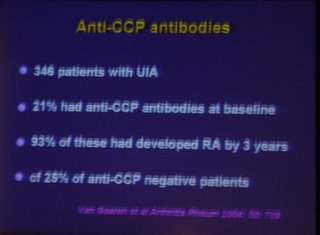
Possibly, we know that anti-CCP positive patients with UIA are more likely to develop RA: 21% of UIA are CCP+, of those 93% develop RA, but 25% of CCP- also develop RA. In one talk this meeting it was suggested that a clinical prediction rule using 9 variables (including CCP) was able to assign patients such that only 6% of those predicted not to develop RA actually did go on to RA. This needs to be tested prospectively but if it does hold true, we need to consider if delaying treatment in this 6% with RA is acceptable. Clearly some members of the audience did not think it was. I will continue to treat all UIA/PISA with DMARDs for the time being.
I do wonder though if it might be feasible to use anti-CCP status to inform decisions about withdrawing DMARDs in that group which enters remission. They have either really gone into remission or are held in remission by treatment. It would seem reasonable to give greater consideration to stopping DMARDs in the CCP negative cases...but I do not think there is evidence to support this.
2. Which DMARD to use in early inflammatory arthritis?
The easy answer is...one that works. But which to try first? If monotherapy is used it looks as if it should be with more intensive follow-up and tight control of synovitis (IM/IA steroids?). I tend to use MTX but the TICORA study did well with SASP as the initial drug.
MJM

Thursday, June 22, 2006
EULAR 2006
Today has been a busy day at the conference, and my internet time is running out...so this will have to be quick, key points only.
The question was raised again as to whether Anti-CCP positive/negative Rheumatoid disease is different. One postulation is that proteins become citrillunated (by smoking for example) and subjects with the shared epitope variants of DR4 then develop anti-CCP antibodies. The Prompt study from yesterday showed that MTX had no impact on the evolution of anti-CCP negative undifferentiated arthritis to RA, but in anti-ccp positive UA MTX significantly reduced the evolution to RA. Treatment with anti-BLys antibodies was also less effective in CCP negative RA.
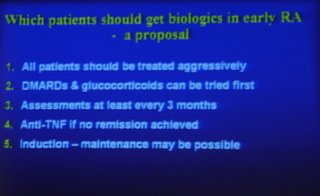
Much talk about the best use of DMARDs...use early in adequate doses (dare I say aggressive doses?), monitor frequently and adjust to control disease (as in the TICORA study). Consider checking anti-CCP status in RF negative inflammatory arthrtis.
Treatment of refractory RA (ie failed MTX and one anti-TNF)
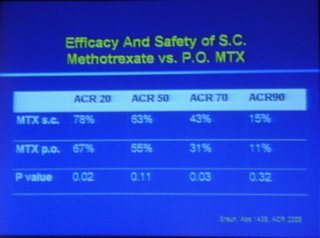
Optimise DMARD: dose to 25mg/week, change PO to SubCut, use a split dose (more on that later)
Optimise Anti-TNF: dose, frequency
Switch TNF: more useful for secondary failures (ie worked initially) than primary failures
Use another biologic: Abatacept, Rituximab.
Just a short note for now since my internet connection is about to run out of money.


PS split dose MTX: taking some in the evening and some next morning may improve bioavailability of higher doses (above 15mg) but the evidence is limited. Worth a try if all else fails though.
MJM
The question was raised again as to whether Anti-CCP positive/negative Rheumatoid disease is different. One postulation is that proteins become citrillunated (by smoking for example) and subjects with the shared epitope variants of DR4 then develop anti-CCP antibodies. The Prompt study from yesterday showed that MTX had no impact on the evolution of anti-CCP negative undifferentiated arthritis to RA, but in anti-ccp positive UA MTX significantly reduced the evolution to RA. Treatment with anti-BLys antibodies was also less effective in CCP negative RA.
Much talk about the best use of DMARDs...use early in adequate doses (dare I say aggressive doses?), monitor frequently and adjust to control disease (as in the TICORA study). Consider checking anti-CCP status in RF negative inflammatory arthrtis.
Treatment of refractory RA (ie failed MTX and one anti-TNF)
Optimise DMARD: dose to 25mg/week, change PO to SubCut, use a split dose (more on that later)
Optimise Anti-TNF: dose, frequency
Switch TNF: more useful for secondary failures (ie worked initially) than primary failures
Use another biologic: Abatacept, Rituximab.
Just a short note for now since my internet connection is about to run out of money.


PS split dose MTX: taking some in the evening and some next morning may improve bioavailability of higher doses (above 15mg) but the evidence is limited. Worth a try if all else fails though.
MJM
Sunday, June 04, 2006
History of Thiamine


Wardround 2vi6
This week’s two minute tutorials were themed around diabetes:
Diagnosis and investigation (JCM)
Presentations (CC)
Complications (EB)
Oral hypoglycaemics (JA)
Diet (RS)
Insulin ℞ (VA)
Well researched talks overall, and several well timed to the two minutes. I was surprised by the fact that by 55 years of age 35% of patients with T1DM would have died from MI. Nice touch by VA to have used the diabetes specialist nurses as a source. If you want to read a quick (<15 minutes ) review of DM try these documents:
http://www.emedicine.com/emerg/topic133.htm
http://www.emedicine.com/emerg/topic134.htm
For next week the topic is renal:
Assessment of renal function (JCM)
Causes of acute renal failure (VA)
Management of ARF other than dialysis (EB)
Dialysis in ARF (CC)
Complications of CRF (PS)
Remember, two minutes only, so keep it concise and precise. Quote your sources.
The reading last week was A Mysterious Death. Oldach DW et al. NEJM 1998; 338(24):1763-1769. This is a case discussion of the death of Alexander the Great. The systematic approach to differential diagnosis is instructive, and the paper should act as a trigger to revise the features of those diseases mentioned. Perhaps if we do this paper again it would be useful to combine it with the two minute talks to revise the features of the major diagnoses discussed? Comments please?
For next time the reading is: Spellbinding and spellbreaking in convalescence. George Day. Lancet 1961; 279 (7222):211-213. Log on to the NHS Scotland elibrary with your Athens password and choose the Lancet. You will be offered several sources, choose the Sciencedirect Lancet site. If you have trouble (you shouldn’t) come and find me...I have a hard copy.
MJM
Diagnosis and investigation (JCM)
Presentations (CC)
Complications (EB)
Oral hypoglycaemics (JA)
Diet (RS)
Insulin ℞ (VA)
Well researched talks overall, and several well timed to the two minutes. I was surprised by the fact that by 55 years of age 35% of patients with T1DM would have died from MI. Nice touch by VA to have used the diabetes specialist nurses as a source. If you want to read a quick (<15 minutes ) review of DM try these documents:
http://www.emedicine.com/emerg/topic133.htm
http://www.emedicine.com/emerg/topic134.htm
For next week the topic is renal:
Assessment of renal function (JCM)
Causes of acute renal failure (VA)
Management of ARF other than dialysis (EB)
Dialysis in ARF (CC)
Complications of CRF (PS)
Remember, two minutes only, so keep it concise and precise. Quote your sources.
The reading last week was A Mysterious Death. Oldach DW et al. NEJM 1998; 338(24):1763-1769. This is a case discussion of the death of Alexander the Great. The systematic approach to differential diagnosis is instructive, and the paper should act as a trigger to revise the features of those diseases mentioned. Perhaps if we do this paper again it would be useful to combine it with the two minute talks to revise the features of the major diagnoses discussed? Comments please?
For next time the reading is: Spellbinding and spellbreaking in convalescence. George Day. Lancet 1961; 279 (7222):211-213. Log on to the NHS Scotland elibrary with your Athens password and choose the Lancet. You will be offered several sources, choose the Sciencedirect Lancet site. If you have trouble (you shouldn’t) come and find me...I have a hard copy.
MJM
Monday, May 22, 2006
Wardround 19v6
 A thing of beauty is a joy forever. Even my nemesis pictured here.
This week's two minute tutorials were a challenge; such broad subjects, inflammatory bowel disorders, so little time. Very interesting though. If you email your talks to me I will incorporate them in the blog.
The week's Reading had been The Iowa Car Crop by S E Landsberg. I had asked you why you thought I had chosen it and how it might be relevent to medicine. HmmmH.... I admit to being seduced by the first three lines: "A thing of beauty is a joy forever and there is nothing more beautiful than a succinct and flawless argument." The paper was chosen because any critical criteria I may use for choosing our reading were corrupted by the paper's rhetoric (or more correctly the author's rhetoric). The opening lines appealed to me and so the paper was chosen. The relevance to medicine is two fold. Firstly beware accepting or rejecting papers because of rhetoric rather than substance. the second part relates to the ships that disappear over the horizon and return later loaded with Toyotas. The author suggests that for an economist to analyse this phenomenon it is not necessary to understand the nature of Japan...it is adequate to imagine it a amagic box which convertts wheat into Toyotas. Diagnoses are similar. It is not always necessary to know everything about a patient's disease (indeed we never know everything) in order to produce a workable management plan. It is only important to know those things which are necessary to produce the plan. I do not know the cause of polymyalgia rheumatica, but I do know the prognosis, complications, treatment and differential diagnosis.
Next week's two minute tutorials are related to Hypertension:
Ace inhibitors (TS)
Beta-blockers (EB)
Calcium channel blockers (AJ)
Diuretics (CC)
Non-drug treatment (JCM)
Investigation of HT (MC)
Keep up the excellent standard. Quote your sources, keep it concise and precise.
The reading for the week is A mysterious death. David W Oldach, Robert E Richard, Eugene N Borza, R Michael Benitez. The New England Journal of Medicine. Jun 11, 1998.Vol.338, Iss. 24; pg. 1764, 6 pgs
I am away this week, see you next week. MJM
Sunday, May 14, 2006

Saturday, May 13, 2006
Wardround 12v6
 This week’s theme was Spirochaetal diseases, Syphilis, Yaws, Pinta, Leptospirosis and Lyme disease. I think this was quite a challenge, but the talks were excellent and a good stimulus for further reading on my part. I will try to get the fact sheets you made scanned and made available, but if you could email the files to me it would be easier.
Next week’s theme is inflammatory bowel diseases: UC, Crohn’s, Coeliac, C.difficile. You have your assignments. Two minute talks please, concise and precise.
This week’s reading was Clinical craft: a lesson from Liverpool. D M Gore Journal of Medical Ethics 27:74-75 (2001). "Surely now is a good time to revisit the concept of clinical craft. ... we also need a certain amount of pride to keep up our morale. By celebrating our craft we can identify with skilled workers anywhere." Pride in a job well done is a precious crop, full of nourisment for the spirit and vitamins for the soul. It is all too easy to tend the plant but allow the fruit to wither on the branch or fall to rot on the ground. My advice: Take some time each week to reflect on what you have achieved as an individual or as part of a team.
For next week I have chosen a different subject: The Iowa Car Crop, S E Landsburg, from The Armchair Economist (1995). I have left a copy on the ward. I would like you to read this and ponder two things: why I have chosen it and what relevance it has for medicine.
Interesting topics this week
SIRS (Systemic inflammatory response syndrome) with hypoxia, eosinophilia, myalgia and anti-MPO antibodies.
CSS
SIRS
Eosinophilia myalgia syndrome (as a fascinoma)
Ultrasound for pleural effusions
Staph. septicaemia. How to confirm SBE; do you know the Duke criteria? And if you do....Are they useful in clinical practice?
MJM
Sunday, May 07, 2006
Wardround 5v6
The two minute tutorials this week were themed around common drugs: Furosemide, Coamoxiclav, Metformin, Citalopram, Omeprazole. It is always useful to focus on those things that would otherwise be part of the background. It was clear that there were important actions one can take when assessing a patient taking one of these agents.
Has it been effective? Is it still needed? Can it be withdrawn? should that be rapid or slow? Are there warnings for the patient? do those warnings change the patient's views about using the treatment.
What sticks in my mind? Do not stop citalopram abruptly, warn patients on PPIs about infection risks (and how to reduce them), warn patients to stop metformin if they become breathless or are vomiting, beware clavulanic acid (coamoxiclav) with liver disease.
The reading this week was Bandolier: What patients think. A comment on the Original paper: PN Trewby et al. Are preventative drugs preventive enough? A study of patients' expectation of benefits from preventive drugs. Clinical Medicine 2002 2: 527-533. There seems to be a gap between the risk/benefit thresholds exhibited by doctors and patients, at least in so far as this study shows.
The Bandolier comment includes "This is an interesting and imaginative paper that tells us what patients think. Half were happy to take a preventive drug if the hypothetical five year absolute risk reduction was 20%, or an NNT of 5. ..... There is a clear discrepancy. Few preventive medicines for preventing heart attacks would seem to meet patient expectation.... the power of the doctor to advise. If their doctor recommended it, more than twice as many subjects would take the medicine. This, though, imposes a significant burden on doctors properly to inform their patients. Much less attention has been paid to how patients think about their own versus population benefit, and especially how the information is presented. "
Interesting topics this week:
Trigeminal neuralgia and Lyme disease
Next week's two minute talks are themed around spirochaetes (I hope Dr Jones has handed out the assignments).
The reading for next week is: Clinical craft: a lesson from Liverpool. D M Gore Journal of Medical Ethics 27:74-75 (2001)
MJM
Has it been effective? Is it still needed? Can it be withdrawn? should that be rapid or slow? Are there warnings for the patient? do those warnings change the patient's views about using the treatment.
What sticks in my mind? Do not stop citalopram abruptly, warn patients on PPIs about infection risks (and how to reduce them), warn patients to stop metformin if they become breathless or are vomiting, beware clavulanic acid (coamoxiclav) with liver disease.
The reading this week was Bandolier: What patients think. A comment on the Original paper: PN Trewby et al. Are preventative drugs preventive enough? A study of patients' expectation of benefits from preventive drugs. Clinical Medicine 2002 2: 527-533. There seems to be a gap between the risk/benefit thresholds exhibited by doctors and patients, at least in so far as this study shows.
The Bandolier comment includes "This is an interesting and imaginative paper that tells us what patients think. Half were happy to take a preventive drug if the hypothetical five year absolute risk reduction was 20%, or an NNT of 5. ..... There is a clear discrepancy. Few preventive medicines for preventing heart attacks would seem to meet patient expectation.... the power of the doctor to advise. If their doctor recommended it, more than twice as many subjects would take the medicine. This, though, imposes a significant burden on doctors properly to inform their patients. Much less attention has been paid to how patients think about their own versus population benefit, and especially how the information is presented. "
Interesting topics this week:
Trigeminal neuralgia and Lyme disease
Next week's two minute talks are themed around spirochaetes (I hope Dr Jones has handed out the assignments).
The reading for next week is: Clinical craft: a lesson from Liverpool. D M Gore Journal of Medical Ethics 27:74-75 (2001)
MJM
Tuesday, May 02, 2006

Common drugs
This week’s paper for discussion is not a real paper, but a comment. I did promise a brief paper for this week. You can of course read the original if it suits you to so do. The reading is from Bandolier: What patients think.
Original paper: PN Trewby et al. Are preventative drugs preventive enough? A study of patients' expectation of benefits from preventive drugs. Clinical Medicine 2002 2: 527-533.
The two minute tutorials are themed about common drugs: Furosemide, Metformin, Citalopram, Omeprazole, Coamoxiclav. Remember, two minutes only. Be concise and precise, quote sources and a handout please.
MJM
Original paper: PN Trewby et al. Are preventative drugs preventive enough? A study of patients' expectation of benefits from preventive drugs. Clinical Medicine 2002 2: 527-533.
The two minute tutorials are themed about common drugs: Furosemide, Metformin, Citalopram, Omeprazole, Coamoxiclav. Remember, two minutes only. Be concise and precise, quote sources and a handout please.
MJM
Sunday, April 16, 2006


Saturday, April 15, 2006
Wardround 14iv6
This week’s two minute tutorial theme was monoarthritis. We heard about Gout (CC), Investigation (GYD), septic arthritis (KP), RA (DK), epidemiology (MH) and pseudogout (SM).
I found the talks detailed and well delivered. A deal of work obviously went into each talk but I award the prize this week to Dr Pearson for a well presented talk with just the right amount of information for two minutes, a clear handhout and citing of sources.
In the approach to monoarthritis the important considerations are:
Is this a problem in a joint (arthritis)?
Is it monoarthritis (or are more joints involved)?
Then get some synovial fluid or get someone who can and ask yourself "How likely is sepsis? can I exclude it?"
The latter question is critical especially in the setting of acute monoarthritis, or sub-acute monoarthritis in the immunocompromised patient. I generally take the view that when I cannot show it is not sepsis, it should be treated as septic arthritis until an alternative diagnosis is found.
Remember that gonococcal arthritis presents differently to non-gonococcal pyogenic arthritis. (have a look at UpToDate)
A podcast will follow soon, until then, a useful description can be found in Infection and arthritis.
Next week’s theme is connective tissue diseases:
SLE (GYD)
Sjögren’s Syndrome (PK)
Myositis (MH)
Systemic sclerosis (CC)
Behçet’s disease (SM)
Diagnosis (DK)
These will be difficult to squeeze into two minutes, so you will have to choose your information carefully. Try to think about the assignment as relating to a patient coming to the clinic. What are the important points you would highlight for a student? Be concise and precise, and cite your sources. And why not try to learn a little more be asking yourself what you know about the subjects your colleagues will be talking about?
Interesting topics this week:
I recommend you have a look at the NEJM’s video on arterial line placement.
Lobar Collapse
The lobar collapse tutorial.
Migratory arthritis (turned out to be CPPD, but make sure you know how to investigate Rheumatic fever)
Next week’s reading will be The rest is silence. Michael Rowe. Health Affairs, July/August 2002; 21(4): 232-236. I recommend you read this unhurriedly and with plenty of time for reflection.
MJM
I found the talks detailed and well delivered. A deal of work obviously went into each talk but I award the prize this week to Dr Pearson for a well presented talk with just the right amount of information for two minutes, a clear handhout and citing of sources.
In the approach to monoarthritis the important considerations are:
Is this a problem in a joint (arthritis)?
Is it monoarthritis (or are more joints involved)?
Then get some synovial fluid or get someone who can and ask yourself "How likely is sepsis? can I exclude it?"
The latter question is critical especially in the setting of acute monoarthritis, or sub-acute monoarthritis in the immunocompromised patient. I generally take the view that when I cannot show it is not sepsis, it should be treated as septic arthritis until an alternative diagnosis is found.
Remember that gonococcal arthritis presents differently to non-gonococcal pyogenic arthritis. (have a look at UpToDate)
A podcast will follow soon, until then, a useful description can be found in Infection and arthritis.
Next week’s theme is connective tissue diseases:
SLE (GYD)
Sjögren’s Syndrome (PK)
Myositis (MH)
Systemic sclerosis (CC)
Behçet’s disease (SM)
Diagnosis (DK)
These will be difficult to squeeze into two minutes, so you will have to choose your information carefully. Try to think about the assignment as relating to a patient coming to the clinic. What are the important points you would highlight for a student? Be concise and precise, and cite your sources. And why not try to learn a little more be asking yourself what you know about the subjects your colleagues will be talking about?
Interesting topics this week:
I recommend you have a look at the NEJM’s video on arterial line placement.
Lobar Collapse
The lobar collapse tutorial.
Migratory arthritis (turned out to be CPPD, but make sure you know how to investigate Rheumatic fever)
Next week’s reading will be The rest is silence. Michael Rowe. Health Affairs, July/August 2002; 21(4): 232-236. I recommend you read this unhurriedly and with plenty of time for reflection.
MJM
Subscribe to:
Posts (Atom)