Monday, April 30, 2007

Wardround 27iv7


Next week’s two minute tutorial theme will be psychiatric disease on the medical unit. So that we might might avoid unpleasant embarrassment we will limit this to psychiatric disorders manifest by patients rather than staff.

Drug associated psychiatric disorders SS
Delerium RP
Acute psychosis DK
Depression TJ
Schizophrenia CS
Alcohol RK

Remember two minutes only. The aim is to inform the group. Keep the talks concise yet precise, and quote your sources.

The read and think last week was White coats and fingerprints: diagnostic reasoning in medicine and investigative methods of fictional detectives. C Rapezzi, R Ferrari, A Branzi. BMJ 2005;331:1491-1494 (24 December), doi:10.1136/bmj.331.7531.1491. There is additional material on bmj.com.

I feel that the discussion was rather limited so we will have another go at the same paper this week.

Interesting topics
Brain tumours

Status Epilepticus: have alook at the topic at http://www.eboncall.org/

Interesting fact: if the stroke volume of the left heart becomes reduced by 1ml compared to the right ventricle, about a litre of extra blood will accumulate in the lungs within 15 minutes.

MJM

PS why the garden of earthly delights?

Sunday, April 22, 2007

Wardround 20iv7


This week’s two minute tutorial
theme was Neuropathy. SS gave us a strategy for investigation and will update/reorder it for next week. My own approach is in four steps: to classify the neuropathy as acute, sub-acute or chronic then as sensory, motor, autonomic or mixed, followed by an initial screen for the most common causes. What do you think that screen should comprise? Step four is NCS and everything else.

For next time we will review glomerulonephritis. The assignments will be:
Nephritic syndrome DK
Nephrotic syndrome LF
Classification CS (make it useful for MJM)
IgA nephropathy TJ
Membranous GN SS

Remember two minutes only. The aim is to inform, rather than hypnotise, the group so keep the talks concise yet precise, and quote your sources.

The reading for next week will be White coats and fingerprints: diagnostic reasoning in medicine and investigative methods of fictional detectives. C Rapezzi, R Ferrari, A Branzi. BMJ 2005;331:1491-1494 (24 December), doi:10.1136/bmj.331.7531.1491

Interesting topics
Trifascicular block (ECG and look it up in uptodate)
Non-epileptic attack disorder
Serratia Marcescans

MJM

Monday, April 02, 2007

Wardround 29iii7

What is this?

This week’s talks were about diarrhoea. If you want to read more, UpToDate has overviews or acute and chronic diarrhoea. For next week the two minute tutorials will be on Neuropathy:

Acute DK
Chronic CS
Investigation SS
Treatments FY1
Diabetic JT
Alcohol related Dr R

Two minutes please . Keep if concise yet precise. Make a one page handout and quote your sources.

The reading was Clinical decision-making: Coping with uncertainty. A F West; R R West. The paper 's conclusion is :Improving scientific knowledge is clearly a laudable objective, although it may reduce clinical uncertainty less than expected. Pretending that the clinical predicament can be reduced to a series of certainties by the recruitment of "evidence" will not work and unrealistic expectations of that stratagem may make the situation worse. Some degree of uncertainty was always here to stay and evidence, even of the highest quality, is only evidence. There will always be judgments to be made by responsible, informed, and compassionate people. They may not be able to perform these broader roles, in communication, holding anxieties and managing uncertainty, unless trained for and supported in them.

The reading for next week is Clinical diagnostic strategies. Sackett DL et al. Chapter 1 of Clinical Epidemiology. I have put a copy on the ward.

Interesting topics

Atrial fibrillation

MJM

Monday, March 26, 2007

Wardround 23iii7

This week’s two minute tutorials were on the investigation of a patient with abnormal LFTs. My test, if it can be called that, for each talk is to ask “Would it be useful for a new resident”. I am not sure that the talks did that. The bones of what to do and what it means seem to have been lost in the telling. Could I ask each person to post one sentence in the comments, please - on your topic.

The reading was Lying to Each Other. When Internal Medicine Residents Use Deception With Their Colleagues. Michael J. Green, et al. Arch Intern Med. 2000;160:2317-2323. An unsuspected side effect was that several of you could not access the paper. Try again. Remember to log in to the elibrary before navigating to the paper. The conclusion of the paper was, in brief, “A substantial percentage of internal medicine residents report they would deceive a colleague in various circumstances, and the likelihood of using deception depends on the context. While lying about clinical issues is not common, it is troubling when it occurs at any time. Medical educators should be aware of circumstances in which residents are likely to deceive, and discuss ways to eliminate incentives to lie.” We discussed ways of controlling lying. One being to be open to criticis. Perhaps the more insidious lies though are those we use internally to guide decisions. They are not open to scrutiny and will remain hidden, but can exert significant effects.

The two minute talks for next week are about diarrhoea. So two minutes please on:
Clinical assessment for diagnosis and definition TJ
Traveller’s diarrhoea DK
Investigation DL
Hospital acquired CS
Elderly out-patients DF
Keep it precise and concise. Make the handout count.

The reading for next week is Clinical decision-making: Coping with uncertainty. A F West; R R West. Postgraduate Medical Journal 2002;78:764

Interesting topics

Cor Pulmonale

TRAPS


MJM

Monday, March 19, 2007

Wardround 16iii7

This week's discussion and tutorials were based on the plague of Athens as described by Thucydides. The diagnoses suggested were: Ebola (DF), Anthrax (RT), Unknown (DK), and Measles (DL). You might want to reflect that each of you chose an 'organism' rather than a 'syndrome'. Dr Taylor might dispute this having described different clinical syndromes of anthrax, but her diagnosis was still organism based. Infectious disease diagnosis in clinical practice is ususally of a clinical syndrome first and possible organisms (note the plural) next.
If you would like to see a published discussion about the plague of Athens have a look at The cause of the plague of Athens: plague, typhoid, typhus, smallpox, or measles? Burke A. Cunha, Infect Dis Clin N Am 18 (2004) 29–43.

The prize for best argument/talk this week goes to DF.

Next week's talks are about the approach to a patient with abnormal LFTs:
Imaging (DL)
Viral serology (DF)
Autoimmune serology (DK)
Genetic screening (RT)

Keep to time, no more than two minutes and try to base the talk on the clinical scenario of a patient with abnormal LFTs.

This week’s readings are about lying. First I would like you to read Hugh Gallagher’s essay which can be found at this site. Then brace yourself and read Lying to Each Other. When Internal Medicine Residents Use Deception With Their Colleagues. Michael J. Green, et al. Arch Intern Med. 2000;160:2317-2323. Which you can get via the elibrary.

Is it ever right to lie? If so, when?

If you feel like reading more (but no fibbing) you might like Truth-Telling in Clinical Practice and the Arguments for and Against: a review of the literature. A. G Tuckett. Nursing Ethics, September 1, 2004; 11(5): 500 - 513.


MJM

Sunday, March 11, 2007

Wardround 9iii7

This week we had two minute talks on the various waves and segments of the ECG. My prize for the best talk/handout goes to DF. I have a list of normal values on this wiki.

The reading for discussion next Friday is the description of the plague of Athens in The History of the Peloponnesian War written by Thucydides in 431 B.C. If you click on the link it will take you to a copy of the piece. The web page begins with chapter VI, but you can skip down to chapter VII (unless you would like to read about the war). If you cannot find the right section, press ctrl-F and type in plague.

You need to have an opinion on the diagnosis and be prepared to argue your corner. Make sure you revise the signs and symptoms of the disease you choose. Your two minute tutorials should be aimed at convincing a sceptical consultant (Dr YT) that your diagnosis is correct.

Furthermore, give some thought as to how you would work up such cases if they pitched up on MAU during your take.

Interesting topics
Transient Global Amnesia


MJM

Sunday, February 25, 2007

Wardround 23ii7

This week’s two minute talk theme was hyponatraemia. My prize for the best talk goes to DF, a well structured and informative two minutes with a good handout to boot. I would summarise the subject by saying virtually all hyponatraemia is due to ADH excess. The challenge is to identify whether the ADH excess is appropriate or inappropriate. Checking plasma osmolality will alert you to the presence of pseudohyponatraemia or the presence of hyperglycaemia. Urine osmolality is the quick check for ADH secretion - if the osmolality is below 100 in a setting of hypo-osmolar plasma then ADH is suppressed, as in psychogenic polydipsia. Urine sodium excretion will help to differentiate appropriate and inappropriate ADH if other clinical clues have not already made the penny drop.

We briefly discussed the paper Clinical craft: a lesson from Liverpool. D M Gore. Journal of Medical Ethics 27:74-75 (2001). The author comments that Any clinician is a practitioner of a craft; assessing a patient by history and examination, addressing diagnostic possibilities, counselling patient and relatives. Many clinicians have technical craft skills on top, surgeons in particular, but no clinician practises well with technical skill alone. Our basic clinical and ward-management skills tend not to be celebrated as they might; they're not particularly exciting, novel or high-tech. .... But we also need a certain amount of pride to keep up our morale. This last sentence, true of every craft, is one which we should keep in mind.

Next week's two minute talks will be the ECG. You have your assignments. I will not be there to hear the talks but will be happy to hear them the following Tuesday if you are up to it. Remember to keep the talks concise yet precise. If you give too much information, none will be remembered.

The read and think for the coming week is In a stew. Michael A Lacombe. American Journal of Medicine. 1991;91:276-278.

Interesting topics

Hemiplegia following a sneeze


MJM

Sunday, February 18, 2007

Wardround 17ii7


This week we discussed the bone profile (calcium, phosphate, magnesium, vitamin D). Can I ask each of you to post one sentence in the comments section with the most useful/interesting fact from your talk please.

The next two minute assignments are on hyponatraemia. The aim, remember, is to give a practical and memorable talk on your given subject in just two minutes. You have to be harsh in keeping the information to the most essential. The test of success is that at the end of the discussion we should be able to diagnose and treat the condition.

Sodium homeostasis (RT)
Investigation (GB)
Causes 1, Causes 2 (up for grabs)
Treatment (DL)
Encephalopathy (DF)

The reading for next week is Clinical craft: a lesson from Liverpool. D M Gore. Journal of Medical Ethics 27:74-75 (2001).

Interesting topics
Cough Headache
Lewy body dementia

MJM

Sunday, February 11, 2007

Wardround 9ii7


This week saw a new batch of trainees so we were kinder than usual. No prepared talk was required...just an unprepared one was asked for. For next week however we are back to the usual routine.

Next Week’s tutorial topic is the bone profile: so two minutes please on:
Calcium
Phosphate
Magnesium

Remember, just two minutes. Keep it concise yet precise, quote your sources and produce a handout. I think it is time to re-introduce the weekly prize (intellectual kudos only).

The reading for next week is The road to recovery. Is it time to bid farewell to the drug reps? David Psetsky

Read it and think. Share your views.

Interesting topics this week
PEG tubes

Just a short blog this week since I have been struck down by a FLI. (Oh how I enjoyed guessing which cytokines were producing each symptom. Damn you Il-1)

MJM

Friday, January 26, 2007

Wardround 25i7


The theme for this week’s two minute talks was Falls.. This fitted nicely with the week’s paper which was Will My Patient Fall? David A. Ganz; Yeran Bao; Paul G. Shekelle; Laurence Z. Rubenstein. JAMA 2007;297 77-86

Dr Gunn told us that falls are common with anannual incidence of 30-40% in the over 65s. Her number crunching paper also highlighted that 10-15% of falls result in a fracture and that one in four of the elderly who fracture a hip die within 6 months. Of the survivors of hip fracture 50% do not return to independent living.

Dr Richardson gave us a comprehensive list of cases of falls on his handout and suggested we use the mnemonic DIME to remember these: Disease, Impairment, Medication, Environment. Lets see who can recall the acronym next week. Thiamine all round to those who forget.

Dr Bayati outlined the investigations that could be employed in identifying patients at risk of falls and finding correctable aspects.

Dr Rymaczeska talked about reducing falls by multidisciplinary input (what’s that?). Important specific points were limiting the number of medications, modifying home hazards, education and exercise.

The JAMA paper concludes with Falls are a treatable geriatric syndrome. Screening for fall risk is as easy as asking, “Have you had any falls in the past year?” and then inquiring about gait or balance problems if the patient has not had a fall. Screening is the first step in preventing future falls and the major injuries that can result from falling. By performing a multifactorial fall assessment on a patient who screens positive and then treating the patient's risk factors for falling, falls can be reduced by 30% to 40%.

Next Week’s topic is the antibiotic treatment of chronic bacterial infection: so two minutes please on:
Brain Abscess (ZB)
Osteomyelitis (MRy’s successor)
Septic arthritis (MRi)
Endocarditis (HR)
Evidence for OPAT (HG)

The reading for next week is Paying Attention: from Zen and the art of motorcycle maintainence. Robert Pirsig. I have left a copy on the ward.

Interesting topics
Pulmonary embolus
Fractured rib
Cerebral Haemorrhage

MJM

Sunday, January 21, 2007

Wardround 19i7

The two minute talks this week were themed about the resuscitation alphabet: A B C D E. All were well presented, and should be a good starting point to build your own methods. The ABC... is a framework, perhaps analogous to DNA, You have to translate it into something that works. The aim is to do those things that must be done while assigning each its appropriate priority. If you hold in your mind a line like “check the airway”, it must be attached to a list not of all the ways it can be done, but of things you would actually do.

Think it through. Draw a mind map if you like. Make sure, for example, that your system involves way of getting help. I you are an FY1Doc, make sure you take every opportunity to accompany those more senior when they attend resus.

From the discussion we moved on to mention neurological examination. You have each been asked to time your neuro exam. This is not a race, more of a baseline measurement. How about putting your times in the comments section?

We will take Falls as our theme for next week's two minute talks. Assignments will be:
Epidemiology (HG)
Aetiology (MRi)
Investigation (ZB)
Prevention (MRy)
Two minutes only, quote your sources, keep it concise and precise. Practical handouts?

The read and think is related this time:
Will My Patient Fall? David A. Ganz; Yeran Bao; Paul G. Shekelle; Laurence Z. Rubenstein. JAMA 2007;297 77-86


Interesting Topics
HSP
Atrial Flutter

MJM

Sunday, January 07, 2007

Happy 2007


The read and think for this week is Protecting elderly people: flaws in ageist arguments. Michael M Rivlin. BMJ 1995;310:1179-1182 (6 May)

The two minute tutorials for Friday are on the resus/assessment alphabet....A(HG) B(CS) C(AC) D(AM) E(?)

Interesting Topics:
Non-ketotic hyperglycinaemia
Osteomyelitis

Obituary:
Following a long and productive relationship, MJM's elibrary/Athens account has unexpectedly expired. MJM and his Athens account did always get along. He could often be heard haranguing the account with unsavoury language when it failed to log him in efficiently, but those who knew them best recognised a warmth between them. In his grief, he wishes now that he had spent more time with the account. The time he spent reading actual books and journals now seems so tawdry, his infatuation with podcasts and audiobooks brings only shame. He asks that his account be re-incarnated so that he might do all those searches, read all those on-line articles that he sincerely wishes he had done before his account was so unexpectedly taken from him.

MJM

Sunday, December 31, 2006

The Airway

Is the airway patent and protected? Guest podcast by Dr John Rutherford.


MP3 File

Sunday, December 24, 2006

Wardround 22xii6


Merry Christmas!

Our two minute talks this week were on a favourite book/film/text, with relevence to medicine. I am pleased that this produced such an eclectic bag of goodies.

The choices were:

Jaws (Peter Benchley/Steven Spielberg): for, as Mark would have us believe, the inspiration to study shark attacks and develop a plan to manage such attacks.

The House of God (Samuel Shem): Before you walk a path, it is useful to read of those who went before. A must for all residents.

The Oxford Handbook of Clinical Medicine: A torch in the darkness (ignorance) of the first months of training. I am too old to have had one as a resident. Medical books were still in Latin back then. (Abite in malum rem).

My Sister’s Keeper (Jodi Picoult): for the ethical dilemmas. (A Richard and Judy recommendation, no less...so says Mrs Wardround).

Good Bye Lenin (Dir W Becker): truth and deception. Can deception, with the best of intentions, be right?

Scrubs: be presented with medical/ethical dilemmas disguised as comedy. Use as an aid when reflecting on your own actions and decisions...or those of others.

M*A*S*H: ditto.

MJM

Sunday, December 17, 2006

Wardround 15xii6


This week’s two minute talks were about emergencies: I have uploaded Dr Gunn’s summary sheet for anaphylaxis since it so impressed me.

A general learning point for all the emergencies is the need to consider the practicalities as well as the treatment. So get help quickly and put people to use as they show up (e.g. “put a line in the right arm, please”...”go and read the case notes”...”call the ITU consultant” etc). Know the doses of drugs you might need to use urgently. All the emergencies require the usual attention to ABCDE.

Sudden loss of consciousness (MR): get help, ABCDE, remember BM, rashes, OD.

Hypoglycaemia (MR): get help, ABCDE, remember unusual presentations: LOC, fits, TIA, blindness, apparently drunk. Be aware especially in those with chronic liver disease.

Anaphylaxis: get help, ABCDE, lots of fluids, oxygen, adrenaline, chlorpheniramine, steroids. 3mg of adrenaline is 3mls of 1:1000.

For next week’s talks we would like two minutes on your favourite book or film. The only caveat is that it must have a medical connection.

The paper for discussion on Tuesday is A field guide to experts.
Andrew D Oxman, Iain Chalmers, Alessandro Liberati.
BMJ 2004;329:1460-1463


Interesting topics
Pyrophosphate arthropathy

RS3PE

MJM

Sunday, December 10, 2006

Wardround 8xii6


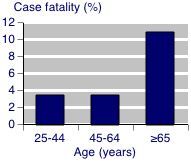
This week’s theme for two minute talks was Adverse Drug Reactions. ADRs are not uncommon and are sometimes fatal. Drug induced agranulocytosis mortality is shown in the figure. Even when an ADR is recognised, its presence may not be flagged up in the final diagnosis and the opportunity to prevent a repeat episode can be lost. When did you last write “Adverse Drug Reaction” in the diagnostic list?

In the talks we heard about:
Non-drug reactions (SS): the importance of asking patients if they are using non-prescribed remedies, the effects of food on drug activity such as pectins/digoxin and broccoli/warfarin.
Prevention (TJ): be aware of interactions with drugs you commonly use and check for interactions when the drug is unusual or has a narrow therapeutic window.
Diagnosis (HG)**: always consider ADR in your differential diagnoses. Be clear about information gathered and consider risk factors.
Warfarin and Antibiotics (RT): always check for interactions and monitor INR daily if interaction is expected. And of course, the second rule of ID, always ask yourself if the antibiotic is really needed.
Penicillins (AM): identify true allergy. Give some thought to the common situation of a patient reporting allergy to an antibiotic but not recalling which one. When you last prescribed an antibiotic did you tell the patient which one it was...or did you say “we’re giving you an antibiotic/a different antibiotic”
Amiodarone (MR): a bit of an aside here...MR, fight your corner, argue for your patient and don’t give in.

**=best talk

I was at a conference recently where one of the speakers had a paroxysm of acronymophilia while talking about ADRs. You will tell from the example that the example was an immunosuppressive agent.

S...Stratify: is the patient at higher risk of an ADR: comorbidities, drugs, age.
A...Assess: Hepatitis status, TB risk, vaccinations up to date?
F...Fend-off: vaccinate, optimise health (stop smoking etc).
E...Evaluate: check what ADRs might be expected, look for them.
T...Treat: nip it in the bud (UTI is easier to treat than septic multi-organ failure).
Y...Yearly: re-evaluate all of the above regularly. The frequency depends on the drug.

I have been contacted by EM from pharmacy, who has asked me to remind everyone about the risk of using ciprofloxacin in patients with epilepsy. And I will take the opportunity to mention the risk of ciprofloxacin in patients with tendonopathy (especially if on steroids). From a more general point of view we discussed the possibility of having a red dot system, similar to that used by radiographers, for the drug kardex. What do you think?

Next week’s two minute talks are on the OMG emergencies. We want to know the practical immediate management of:

Anaphylaxis (HG)
Hyperkalaemia (RT)
Sudden loss of consciousness (MR)
Hypoglycaemia (MR)
Sudden hypotension (TJ)
Sudden hypoxia (DK)

Two minutes please. Keep it concise yet precise and quote your sources. Can we make the handouts a visual aid? We don’t really need the talk written out.

The cardinal paper will be carried over once more...discussion on Tuesday as suggested by HG.

Interesting topics
Mitral regurgitation

ADR Agranulocytosis

Benign intracranial hypertension or alternatively

MJM

Saturday, December 09, 2006

Suspected PE


MP3 File

British Thoracic Society guidelines for the management of suspected acute pulmonary embolism. Thorax 2003;58:470–484

Friday, December 01, 2006

Wardround 1xii6

This week’s two minute talk theme was common investigations. We heard about:

Rheumatoid factor (MJM): present in many inflammatory and infectious illnesses, more useful as a prognostic marker than in diagnosis, and a possible cause of interfernce with immunoassays.
D-dimer (PL) the physician’s bain – thought of as a “rule-out DVT test” by many but actually more of a “profiling the risk of DVT test”, has little practical application in patients who already have high pre-test probability of DVT.

Bilirubin (TJ) measurement may be influenced by food intake.

Glucose (AB): remember that venous and capillary samples give different results by as much as 1 mmol/l. Always get a lab sample at the extremes of results or where hypoglycaemia is suspected in a non-diabetic patient.

Troponin (HG): Excellent talk Dr Gunn: useful prognostic marker in ACIS but must be interpreted with other clinical variables.remember that haemolysed samples will give a spuriously low result. Remember that diseases other than ACIS can cause elevations of troponin and that the timing of the sample with respect to chest pain is important.

CRP (DK): a substance in the serum of patients with acute inflammation that reacted with the C polysaccharide of pneumococcus. Useful to monitor inflammatory activity in view of its short half life. CRP is associated with increased cardiovascular risk. (CRP <1mg/l>3mg/l =high risk).

Urinalysis (SS): have a look at the paper below in interesting topics.


We have deferred the paper for reading until next week. So for next week think about Hope is the thing with feathers. A piece of my mind, Cripe, LD. JAMA 296(15):1815-1816, October 18, 2006. Access it via the elibrary.

For next week’s two minute talks we are addressing adverse drug reactions:
Epidemiology (PA)
Diagnosis (HG)
Important drug interaction I (FY2)
Important drug Interaction II (FY1)
Improving safety (TJ)
Non-drug interactions (SS)

Two minutes only please. Be concise yet precise and quote your sources (not much of that this week). For the Important drug interaction talks choose an important example.

The combined wardround has fallen by the wayside (and been covered with Autumn leaves). It is time to get it going again. The round is difficult when an SHO has to leave at lunchtime so we should begin again (providing GAJ agrees?) on the following Fridays: 15th December, 5th January. Format to be agreed beforehand.

Interesting topics this week:

Sunday, November 26, 2006

Wardround 24xi6

This week's two minutes were themed about 'a patient who changed me/my practice'and with the discussion paper on end of life, turned into quite a discussion. It is useful to reflect on how we change our views as we gain experience and mature and the nature of professional versus societal responsibility.

Next week's two minute tutorials will be based on 'some common tests':
CRP (DK)
Troponin (HG)
D-dimer (PL)
Urinalysis (SS)
Keep it concise and precise.

The paper for reading is A PIECE OF MY MIND, Cripe, Larry D. JAMA 296(15):1815-1816, October 18, 2006. Access it via the elibrary.

Interesting topics
AION
Papilloedema
Drug rashes

MJM

Sunday, November 19, 2006

Wardround 17xi6

A brief blog, sorry.

This week we discussed alternative medicine. I would like to hold on to the concept from the professor of alternative medicine in Exeter: Alternative medicine (as opposed to conventional medicine) is a treatment that has not yet been shown (with scientific rigour) to be effective. By his definition a substantial part of conventional practice is 'alternative'. We should not forget that. I find the NCCAM website http://nccam.nih.gov/ a useful first port of call when a patient asks about a specific complementary treatment.

The read and think for next week will be Measuring quality of life. Is there such a thing as a life not worth living?
Bobbie Farsides,  Robert J Dunlop BMJ 2001;322:1481-1483 ( 16 June ).

I had to leave before the end of the presentations this week so if you already have assignments for next week, do those. If not, let's have two minutes on "an episode which changed me/my practice".

MJM